
A one-star review rarely marks the moment something went wrong. It marks the moment a customer gave up on the private channels, a word to staff, a phone call, a feedback form nobody read, and decided the only way to be heard was in public. By the time a complaint reaches a support queue as a formal ticket, a version of it has often already been sitting in review text for weeks.
The star average is the slowest, most visible signal a business gets. It only moves once enough people have had the same experience and taken the extra step of scoring it. The words underneath the score move earlier, because a mild version of the same complaint shows up in four and five star reviews long before anyone is angry enough to mark a business down for it. Reading the text is reading the rating before it happens.
The average moves last
Treat the rating as a lagging indicator and the rest follows. A location that has held steady for six months can still be two weeks from a visible drop, because the drop is caused by something already showing up in the text: "had to wait", "asked twice", "wasn't told". None of those phrases cost a location a star on their own. Enough of them, repeated by different customers using different words for the same thing, is what eventually does.
Three patterns worth watching
Three signals are worth tracking before anything shows up as a lower average.
- The same noun, several locations. "Parking", "the wait", "the app" turning up across unrelated sites in the same fortnight points to something structural, not one bad shift.
- A new word entering four-star reviews. A four-star review is usually where a customer notes the one thing that stopped an otherwise good visit being perfect. A word that starts appearing there and was not there a month ago is a complaint arriving early, before it is angry enough to be one.
- Mild versions clustering before the sharp ones arrive. One-star reviews about a specific issue are usually preceded by several three and four-star reviews mentioning the same issue more gently. The mild cluster is the leading edge, not background noise.
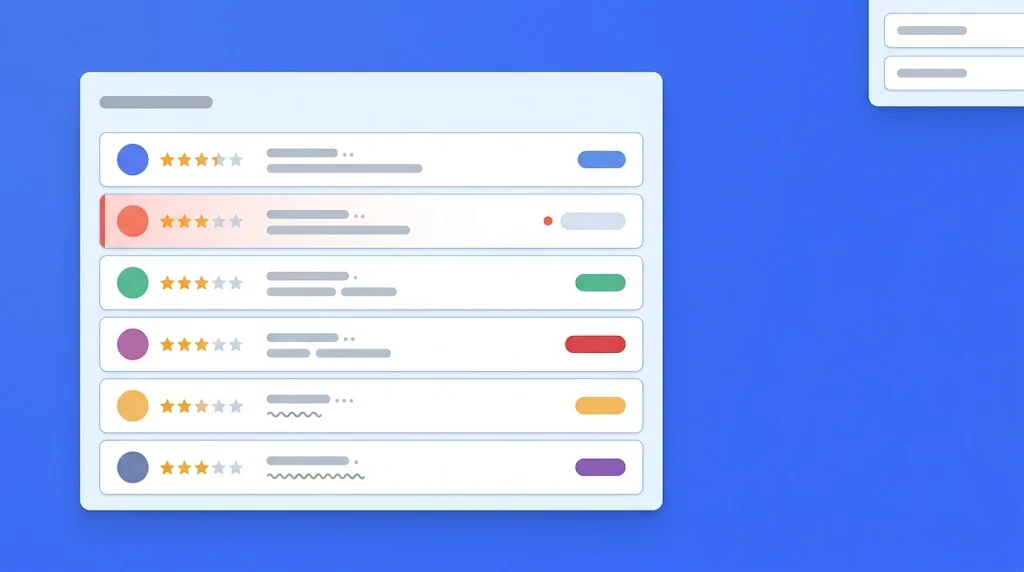
Why per-review scores mislead
It is tempting to score each review's sentiment and watch the number move, but a single review's sentiment score is close to useless on its own. It is noisy, sensitive to phrasing, and tells you about one customer's mood rather than about the business. A handful of mixed reviews can average out to calm right up until the week it does not. What is useful is not a score per review but a trend per theme: whether "staff" is reading warmer or colder over eight weeks, across every location. A theme's slope is a far steadier number than any one review's sentiment.
Route the theme, not the review
A theme is only useful if it lands with someone who can act on it. "Staff" turning cold at three Gurugram locations means little to a marketing team and a great deal to the regional operations lead who schedules those shifts. The habit worth building is routing a rising theme to the owner the moment it starts trending, not once it has produced enough one-star reviews to be impossible to miss. GoCredible groups review text into themes across every location and platform and flags which ones are moving, so a shift shows up as a trend line, not forty unconnected reviews sitting in separate inboxes.
The fifteen-minute read
The operational version of all this is a short, regular habit rather than a dashboard nobody opens. Once a week, someone should read the top three or four moving themes along with a handful of their actual quoted lines, not just the chart, because the words carry context a number strips out.
- Name the theme in plain words, not a category label.
- Decide: fix it, watch it, or note it as normal seasonal noise.
- Assign a named owner before the meeting ends, not "the team".
The single change that makes this stick is the named owner. A theme with no owner gets read again next week in exactly the state it is in now, and the fortnight it bought you is spent for nothing.